
The Letters of Silver Hill: Chapter One
Rain had been falling over London since before dawn, turning the streets around Bloomsbury into long stretches of dark, shining pavement. From the windows of Clara Bennett’s flat, the buildings opposite were blurred behind streams of water, their windows glowing faintly through the grey morning. Every few minutes, a bus passed along the street below, its tyres hissing against the wet road while the muffled voices of pedestrians rose and disappeared beneath the steady sound of rain.
Clara stood in her kitchen with both hands wrapped around a chipped blue mug, watching the rain while her coffee slowly cooled. She wore an oversized charcoal sweater and thick wool socks, and her dark brown hair was loosely tied at the back of her head. Several strands had escaped around her face, but she had stopped caring about them hours ago. Her laptop sat open on the kitchen table, an unfinished article staring back at her, the cursor blinking at the end of a paragraph she had rewritten three times without making it any better.
She had promised her editor that the article would be finished before noon, but she had been awake since six and had managed very little. Clara took another sip of coffee, grimaced when she realized it had already gone lukewarm, and placed the mug on the counter. She was about to return to her laptop when she noticed a small pile of envelopes lying beside the front door.
Clara sighed and crossed the room to collect the post. She picked up the envelopes one by one as she returned to the kitchen, sorting them automatically into their usual categories. There was a bank statement, an electricity bill, a supermarket leaflet, and a letter from her mobile phone provider that she had no intention of opening until necessary.
The final envelope, however, made her stop before she reached the table.
It was made from thick cream paper, and her name had been written across the front in dark blue ink. There was no printed address, no company logo, and no return address anywhere on the envelope. Clara turned it over and discovered a small green wax seal holding the flap closed, with a strange emblem pressed into its centre.
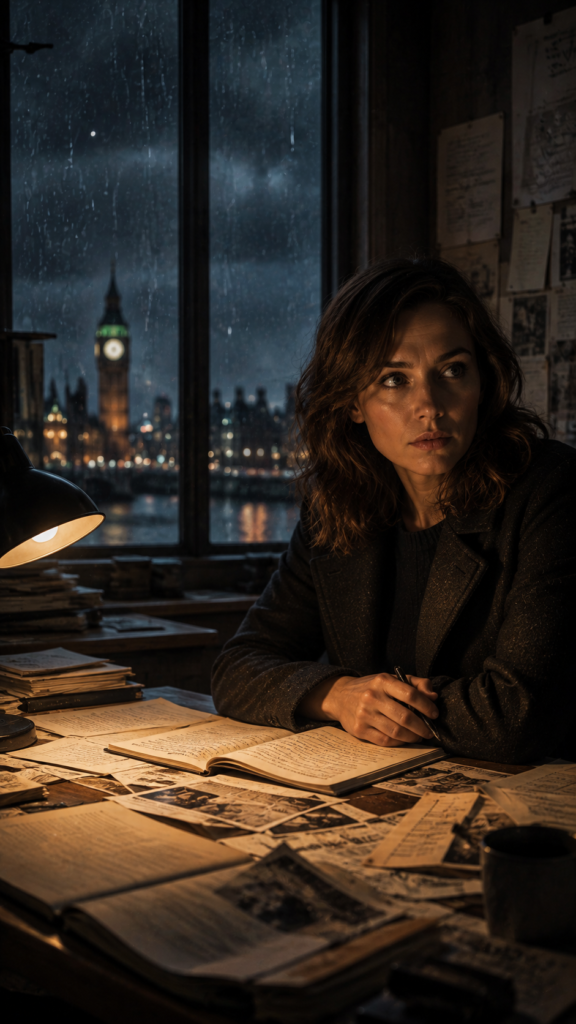
She carried the envelope to the table and sat down, studying it with growing curiosity. The paper felt unusually heavy beneath her fingers, and the handwriting was precise enough to suggest that whoever had written her name had taken considerable care. Clara had received anonymous letters before, some useful and some threatening, but this one lacked the hurried appearance she associated with anonymous correspondence.
“Who sends letters like this anymore?” Clara murmured, although she was alone in the apartment.
She reached for the silver letter opener lying beside her laptop and carefully slipped it beneath the sealed flap. The wax cracked softly as she opened the envelope, and she removed a single sheet of cream-coloured paper. When she unfolded it, she immediately noticed that the handwriting was formal and deliberate, with each line carefully spaced beneath the one before it.
The letter began with a simple greeting, and Clara read the first paragraph slowly. It was from a solicitor named Jonathan Reed, who explained that he represented the late Professor Edward Whitmore.
Clara stopped reading as soon as she saw the professor’s name. She remembered it from the early years of her career.
Professor Edward Whitmore had been a respected historian who specialized in old estates, private collections, forgotten manuscripts, and historical records that had disappeared during periods of war. Clara had once tried to interview him for a magazine article about a collection of letters discovered in an old Yorkshire estate, but after almost two weeks of emails with his assistant, she had received a polite refusal.
Whitmore did not give interviews, his assistant had explained, and that had been the end of the matter. At least, Clara had thought it was.
She continued reading and discovered that Professor Whitmore had died eleven days earlier at his family estate in Northumberland. Before his death, he had left detailed instructions concerning a private collection held somewhere on the property, a collection that had never been properly catalogued and that he had specifically forbidden anyone else from examining.
Clara’s eyes moved to the next paragraph, and she felt her expression change when she saw her own name. Professor Whitmore had requested that Clara Bennett be given access to the collection.
She read the sentence twice before lowering the letter onto the table. The rain continued tapping against the window, but Clara barely noticed it now. She had never met Whitmore, never spoken to him, and had no reason to believe that he even remembered her failed attempt to interview him years earlier.
“Why would he choose me?” Clara asked quietly as she looked down at the letter. There was, of course, no answer.
She picked up the paper again and continued reading. The solicitor explained that Clara would be given access to the collection before any decision was made about its future, and if she accepted the invitation, she was expected to travel to Silver Hill as soon as possible. Someone at the estate would meet her and explain what Professor Whitmore had left behind.
At the bottom of the page, Jonathan Reed had signed his name.
Clara was about to fold the letter when she noticed a sentence written beneath the signature. The handwriting was different from Reed’s, slightly older and less polished, and the ink appeared darker in some places where the writer had pressed the pen firmly into the paper.
Clara leaned closer to read it properly. “There are seven letters that must be read before they disappear.“
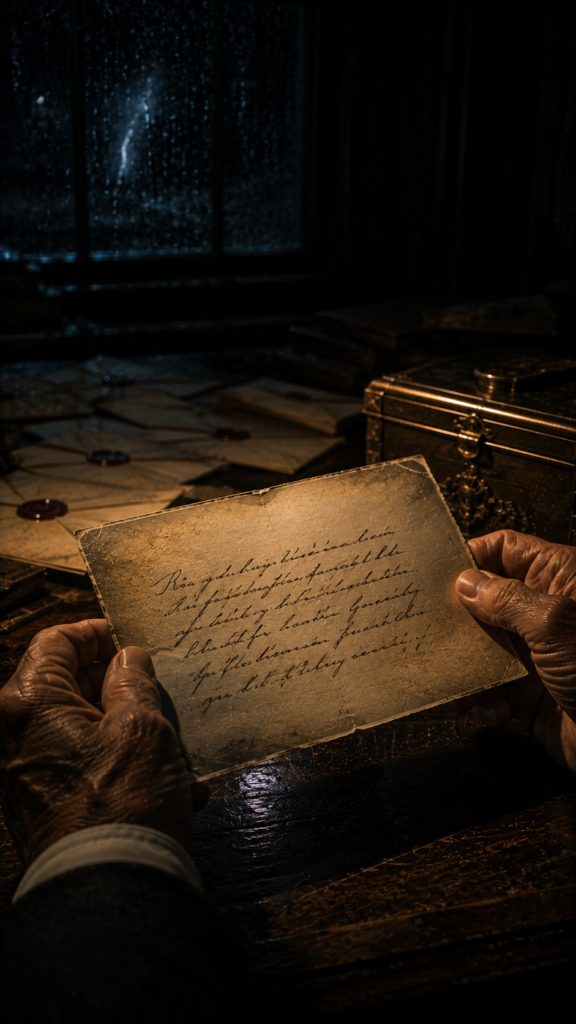
She turned the paper over, but the back was completely blank. Clara held the page toward the window and examined the handwriting again, wondering whether the sentence had been added by Professor Whitmore himself. There was something deliberate about the way the words had been written, particularly the final word, which seemed to have been pressed into the paper with unusual force.
Clara placed the letter on the table and stared at it for several seconds. She didn’t understand what the seven letters were, why they might disappear, or why Professor Whitmore had apparently decided that she was the person who needed to read them. The questions were already beginning to multiply faster than she could answer them.
She picked up her phone and called her sister. Sophie answered after several rings, and her sleepy voice immediately made Clara smile. “You’re calling before nine in the morning, Clara. Should I assume something terrible has happened?”
Clara leaned back in her chair and glanced at the strange letter lying beside her coffee. “Nothing terrible has happened, at least not that I know of. I received a strange letter this morning, and I wanted to talk to you before I make a decision.”
Sophie sounded more awake now, and Clara could almost picture her sitting up in bed on the other end of the call. “What kind of strange letter are we talking about? Strange as in someone sent you an angry complaint, or strange as in you should probably call the police?”
Clara smiled despite herself and ran her thumb along the edge of the paper. “Neither, exactly. It’s from a solicitor named Jonathan Reed, and he represents Professor Edward Whitmore.”
There was a noticeable silence before Sophie answered, and when she finally spoke, the sleep had completely disappeared from her voice. “Professor Whitmore? The historian you tried to interview a few years ago?”
“Yes, that Professor Whitmore,” Clara replied. She looked down at the letter again before continuing. “He died eleven days ago, and apparently he left instructions that I should examine a private collection at his estate in Northumberland.”
Sophie remained quiet for a moment, and Clara could hear faint movement on the other end of the phone. “Why would he choose you?” Sophie asked finally.
Clara picked up her pen and rolled it slowly between her fingers as she considered the question. “That’s exactly what I asked the solicitor. He says he doesn’t know, and honestly, I’m not sure I believe that.”
“Does he know what’s in the collection?” Sophie asked.
“He says he doesn’t.” Clara glanced toward the bedroom, where her suitcase was still stored beneath the bed. “Apparently Whitmore gave very specific instructions about who could access it, but he didn’t explain the contents to his solicitor.”
Sophie let out a long sigh, and Clara could hear the concern in it. “And you’re already thinking about going, aren’t you?”
Clara looked toward the bedroom door and smiled reluctantly. She hadn’t packed yet, but she had already taken her suitcase out of the cupboard and placed it beside the bed.
“I’m considering it,” she replied, knowing perfectly well that her sister would hear the dishonesty in the answer.
“You have your suitcase out, don’t you?” Sophie asked.
Clara laughed softly as she rubbed her forehead. “Possibly.”
Sophie sighed again, but this time amusement was mixed with her frustration. “Clara, you have the worst definition of the word ‘considering’ that I’ve ever heard.”
Clara smiled and looked back at the letter. “You know me.”
“Unfortunately, I do,” Sophie replied. She paused before asking more seriously, “How long are you planning to stay?”
“A few days, probably,” Clara answered. “I don’t know how long it will take to examine everything.”
Sophie asked, “And you’re going alone?”
Clara looked down at the letter and considered the question. “There’s a caretaker at the estate. Her name is Eleanor Price, and apparently she’s been there for more than twenty years.”
Sophie gave a small, impatient laugh. “That isn’t what I meant, and you know it.”
Clara’s expression softened because she understood exactly what her sister was asking. “I’ll be careful,” she assured Sophie.
“You always say that when you’re about to do something I don’t like,” Sophie replied. Clara smiled as she looked toward the rain-covered window. “I’ll call you when I arrive.”
Sophie immediately asked, “Promise?” “I promise,” Clara replied. There was another pause before Sophie spoke again, this time with unmistakable seriousness.
“Clara, if something feels wrong when you’re there, don’t convince yourself that you’re imagining it just because you’re interested in the story.”
Clara’s smile disappeared, and she lowered her eyes to the letter. Her sister knew her better than almost anyone, and Clara knew there was truth in the warning. Her curiosity had always been one of her greatest strengths as a journalist, but it had also made her walk farther into certain situations than she probably should have.
“I won’t ignore it,” Clara promised.
They said goodbye a few minutes later, and Clara placed the phone beside her notebook. She remained at the table for a while, listening to the rain and thinking about Northumberland, Silver Hill, and the seven mysterious letters.
Eventually, curiosity won over caution.
Clara picked up the phone again and dialled the number printed beneath Jonathan Reed’s signature. The solicitor answered after the third ring, and his voice was calm and professional when he introduced himself. “Jonathan Reed speaking.”
Clara straightened in her chair and glanced once more at the strange sentence beneath his signature. “Mr. Reed, this is Clara Bennett. I received your letter this morning, and I hope you don’t mind me calling so soon.”
“Not at all, Miss Bennett,” Reed replied. “I was expecting to hear from you.”
Clara opened her notebook and placed the pen beside it. “I have several questions.”
There was a faint trace of amusement in Reed’s voice when he answered. “I expected that as well.”
Clara looked at the letter and decided there was no reason to waste time. “Let’s start with the obvious question. Why did Professor Whitmore choose me?”
There was a pause on the other end of the line before Reed answered carefully. “I can’t give you a definite answer, Miss Bennett. Professor Whitmore did not explain his reasoning in the instructions he left.”
Clara frowned and began writing notes. “Did he know me personally?”
“No,” Reed replied.
“Did he know my work?” Clara asked.
“I can’t say for certain,” Reed answered.
Clara stopped writing and leaned back in her chair. “Then how did he decide that I was the person he wanted to examine his collection?”
Reed’s answer was simple and unsatisfying. “I don’t know.”
Clara looked toward the window and watched a car move slowly through the rain. “Mr. Reed, you’re asking me to travel to a remote estate belonging to a man I’ve never met so that I can examine documents that even you haven’t seen. You must understand why I find that unusual.”
“I do understand,” Reed replied calmly. “If I were in your position, I would have questions as well.”
Clara tapped her pen lightly against the notebook. “What exactly is in the collection?”
“I’m afraid I can’t tell you,” Reed said.
Clara narrowed her eyes slightly. “Because you don’t know?”
“Because I wasn’t authorized to examine it,” Reed explained.
Clara leaned forward. “You’re his solicitor.”
“Yes,” Reed confirmed.
“And he still wouldn’t show you the documents?”
“Not the documents he specifically left for you,” Reed replied.
Clara wrote that down before looking at the letter again. “How long have those documents been sitting at the estate?”
“Since his death,” Reed answered.
“So they’ve been untouched for eleven days?”
“That is my understanding,” Reed said.
Clara lowered the pen and considered what she had just heard. “What happens if I decide not to go?”
“The collection will be sealed,” Reed replied.
“For how long?” Clara asked.
“Professor Whitmore left no further instructions,” Reed answered.
Clara’s expression tightened. “Who else knows about the collection?”
There was a short pause before Reed answered. “Very few people.”
Clara immediately followed with another question. “Who?”
Reed’s tone became more reserved. “I’m afraid I can’t discuss the family’s private affairs.”
Clara leaned back and gave a small, humourless smile. “You’re very good at avoiding questions, Mr. Reed.”
Reed gave a quiet laugh before answering. “I’ve been a solicitor for twenty-seven years. It’s a useful skill.”
Clara smiled despite herself, but the amusement disappeared when she looked at the handwritten sentence again. She placed one finger beneath the words and followed them slowly across the page.
“There is something else I want to ask you about,” Clara said. “Of course,” Reed replied.
Clara’s voice became more serious. “The seven letters. Where did that sentence come from?”
There was a longer silence this time, and Clara immediately noticed it. Reed finally answered in a quieter voice. “I didn’t write it.”
“I know you didn’t,” Clara replied. “Who did?”
“Professor Whitmore,” Reed answered.
Clara sat forward. “You knew about the letters?”
“I knew that he referred to them,” Reed said.
Clara’s pen stopped moving. “How many are there?”
“Seven.”
“Have you seen them?” Clara asked. “No,” Reed replied.
Clara frowned. “Why not?” “Because Professor Whitmore instructed me not to examine them,” Reed explained.
Clara looked toward the window again, but this time she wasn’t watching the rain. Her mind was already trying to construct a picture of an old man sitting somewhere in Silver Hill, writing instructions about letters that he apparently believed might disappear.
“Did he explain why?” Clara asked.
“No,” Reed replied.
Clara looked down at the paper. “Did he explain why he wanted me to read them?” “No,” Reed said again.
Clara rubbed her forehead and let out a quiet breath. “Mr. Reed, you’re making this sound more mysterious than it probably is.”
“I assure you, Miss Bennett, I have no intention of making anything mysterious,” Reed replied.
Clara looked at the seven words again and decided that she had little patience left for careful legal answers. “Then tell me something useful.”
For several seconds, Reed didn’t answer. When he finally spoke, the confidence in his voice had changed. “I believe Professor Whitmore was frightened,” he said.
Clara’s hand tightened around the pen, and she stared at the letter. “Frightened of what?” “I don’t know,” Reed admitted.
Clara lowered her voice. “But you believe he was afraid?” “Yes,” Reed replied.
“Why?” Clara asked. Reed hesitated before explaining. “Because of the precautions he took before his death.”
Clara leaned forward. “What precautions?” “He instructed me that if anyone other than you attempted to access the private collection, the archive was to be sealed immediately,” Reed explained.
Clara stared at the table for several seconds. “That seems excessive.” “I thought so as well,” Reed admitted.
Clara looked toward the letter. “Did you ask him why?”
“Yes,” Reed replied. “What did he say?”
Reed paused before answering. “He told me that if I thought the precaution was excessive, then I didn’t understand what was in the collection.”
A faint chill moved across Clara’s arms. She reached toward the radiator beside the table, but it was already warm. The sensation had nothing to do with the temperature in the room.
She looked down at the letter once more before making her decision. “Mr. Reed, when can I come?”
“Tomorrow,” Reed replied.
Clara blinked in surprise. “Tomorrow?”
“Professor Whitmore requested that you be given access as soon as possible,” Reed explained.
Clara glanced at her laptop and then at the suitcase still waiting in the bedroom. The unfinished article suddenly seemed unimportant. “All right,” Clara said. “I’ll come tomorrow.”
“I’ll send you the travel details,” Reed promised. Clara opened her notebook and prepared to write. “Who will meet me at the estate?”
“Mrs. Eleanor Price,” Reed answered. “She’s been the caretaker at Silver Hill for more than twenty years.”
Clara wrote the name down before asking, “How far is the estate from the nearest station?” “Approximately forty minutes by car,” Reed explained.
“Is there somewhere nearby where I can stay?” Clara asked. “There’s a small inn in the village,” Reed replied. “I’ll include the details in my email.”
Clara hesitated before asking one final question. “Mr. Reed, did Professor Whitmore leave anything else specifically for me?”
There was a pause before Reed answered. “Not that I’m aware of.” Clara looked at the letter and frowned. “Are you certain?”
“As certain as I can be,” Reed replied. Clara slowly closed her notebook. “I suppose I’ll find out tomorrow.”
“I believe you will,” Reed said.
After they ended the call, Clara remained at the table for several minutes. The apartment seemed strangely quiet now, even though the rain continued outside. Her coffee had gone completely cold, and the unfinished article on her laptop still waited for her, but her attention had moved far beyond London.
She stood and walked into the bedroom, where she pulled her suitcase from beneath the bed. The case was old and scratched from years of travel, but the wheels still worked, and that was all that mattered. Clara placed it on the floor and opened it before returning to the wardrobe.
She packed two notebooks, her camera, spare batteries, a digital recorder, her laptop, several changes of clothes, and a thick coat. After considering the weather forecast for Northumberland, she added an umbrella and her old brown boots. The boots were not particularly attractive, but they were comfortable, and Clara suspected that Silver Hill’s grounds were unlikely to be kind to expensive shoes.
When she finished packing, she returned to the kitchen and found the letter exactly where she had left it. Clara picked it up carefully, folded it along the original crease, and slipped it inside the notebook she intended to carry with her.
She rested her hand on the closed notebook and looked toward the window. Somewhere beyond the rain and the crowded streets of London was an old estate in Northumberland, and inside that estate were seven letters that a dying historian had considered important enough to leave specific instructions about.
Clara had no idea what those letters contained, and she had no idea why Professor Whitmore had chosen her to read them. She didn’t know whether the solicitor had told her everything, and she certainly didn’t understand why a man who had spent his life studying the past had been frightened near the end of it.
What Clara did know was that she was going to Silver Hill.
She carried her suitcase toward the bedroom and placed it beside the door, then returned to the kitchen and picked up her cold coffee. As she stood by the window, watching the rain blur the city outside, she found herself wondering whether Professor Whitmore had known exactly what would happen after his death.
She wondered whether he had known she would accept his invitation, and whether the seven letters had been waiting for her all along. The thought made her uncomfortable, so she pushed it aside and returned to her laptop.
There was still an article to finish before she left London, and whatever waited for her at Silver Hill could remain there until morning. For tonight, Clara intended to concern herself with ordinary things: work, packing, sleep, and the train that would carry her north.
She had no idea that the journey to Silver Hill would become the beginning of a much larger mystery, or that the secrets hidden inside those seven letters would eventually reach far beyond the old estate. For now, she was simply a journalist following an unusual lead, unaware that she had just stepped into a story that had been waiting years for someone willing to read it.