
Chapter Three: The House on the Hill
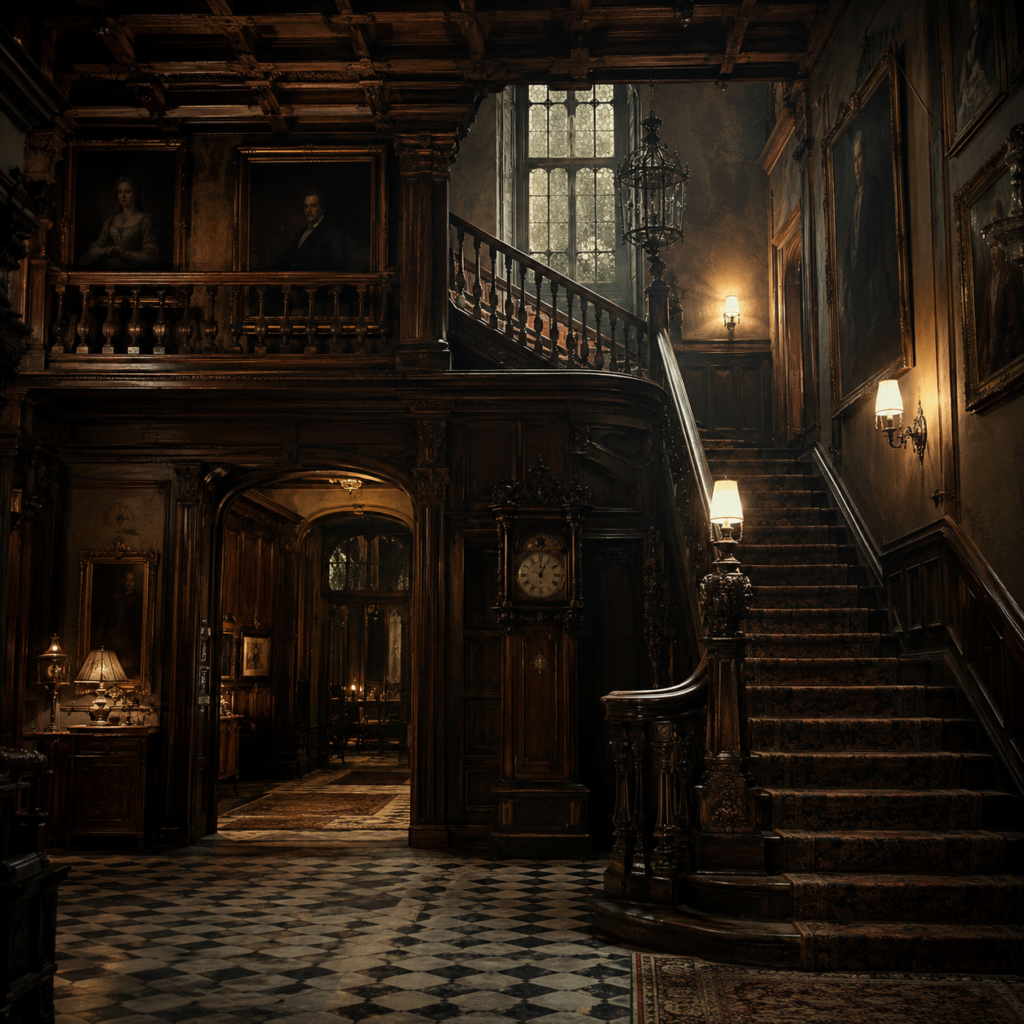
The front doors of Silver Hill were taller than Clara had expected. They were made of dark oak, polished so many times over the years that their surface reflected the warm light from the lamps beside the entrance. Eleanor pushed one of the doors open, and a wave of warmth moved toward them, carrying the faint scents of burning wood, old books, and something floral that Clara could not immediately identify. She stepped across the threshold with her suitcase behind her and found herself standing in an entrance hall that seemed to belong to another century.
The floor was covered with black-and-white tiles worn smooth in places by generations of footsteps, while heavy wooden beams crossed the ceiling above them. An enormous staircase curved upward along the far wall, its polished banister disappearing toward the upper floors. Paintings covered almost every available section of wall, showing stern-faced men and women dressed in clothes from different periods. Near the staircase stood an old grandfather clock, its steady ticking strangely loud in the enormous hall.
Eleanor closed the door against the cold and removed her gloves, slipping them into the pocket of her coat before reaching for Clara’s suitcase.
“Your room is ready,” she said, lifting the suitcase with surprising ease. “You can leave your things there before dinner, and afterward I’ll show you the room where Professor Whitmore kept the collection.”
Clara followed her toward the staircase, keeping her shoulder bag close against her side.
“I thought Mr. Reed said the collection was private,” she said. “Does that mean it’s kept somewhere separate from the rest of the house?”
Eleanor paused briefly at the bottom of the stairs before beginning to climb.
“It is kept in a separate part of the house, but I wouldn’t call it an ordinary room,” she explained. “Professor Whitmore had the area secured several years ago, and very few people were ever allowed inside.”
The older woman continued upward without offering any further explanation. Clara noticed the slight change in her voice. Eleanor had spoken confidently about the house, the journey, and even Professor Whitmore himself, but whenever the conversation turned toward the collection, she seemed to choose her words with considerably more care.
Clara followed her along the staircase and onto a long upper corridor lined with faded portraits and dark wooden doors. A narrow carpet ran along the centre of the polished floor, although the boards beneath it still creaked occasionally beneath their feet. Clara found herself wondering how many people had walked through these corridors over the generations and how many conversations, arguments, celebrations, and secrets had disappeared with them.
Eleanor stopped at the final door on the left and opened it.
“This is the Rose Room,” she said, stepping aside to let Clara enter. “Professor Whitmore kept the name even though the room hasn’t been decorated with roses for many years.”
Clara walked inside and immediately understood why the room had once been given its name. The wallpaper carried a faded pattern of climbing roses, some of the flowers almost invisible beneath years of sunlight and age. Heavy curtains framed a tall window overlooking the gardens, while an old writing desk stood beside the fireplace beneath a brass reading lamp. The bed dominated one side of the room, with a carved wooden headboard and a thick quilt folded neatly across it.
Clara placed her camera bag on the writing desk and walked toward the window. From the upper floor, she could see much more of the estate than she had been able to see from the Land Rover. The lawns stretched down toward a line of dark trees, and a narrow stone path disappeared between them before continuing toward the woods. Beyond the grounds, the valley had begun to fade beneath the blue-grey light of evening.
“The view is beautiful,” Clara said, resting one hand against the window frame. “I imagine it must look completely different in summer.”
“It does,” Eleanor replied.
She remained near the doorway, watching Clara with a thoughtful expression.
“Professor Whitmore preferred it without leaves, though. He used to say that winter made it easier to see who was approaching the house.”
Clara turned away from the window. “Who was he expecting to approach the house?”
For a moment, Eleanor seemed to regret mentioning it. She lowered her eyes before answering. “Visitors, mostly. Researchers, academics, journalists, and people who wanted something from him. Professor Whitmore didn’t always enjoy being around people.”
Clara thought about Jonathan Reed’s description of the precautions Whitmore had taken before his death. “Was he expecting someone before he died? Someone specific?”
Eleanor looked toward the corridor before replying. “He received visitors occasionally, but he didn’t discuss his appointments with me unless he needed something prepared.”
She hesitated before adding, “There were some people he trusted, and others he didn’t.”
Clara noticed the distinction but decided not to pursue it yet. She had already learned that Eleanor became guarded whenever the conversation approached anything connected to Whitmore’s private affairs, and there would be plenty of time to ask questions once she understood more about the house.
She opened her suitcase and removed a sweater, placing it across the end of the bed. “You mentioned dinner. Is anyone else staying at the estate tonight?”
Eleanor shook her head. “No. It’s just the two of us. Professor Whitmore’s relatives live elsewhere, and most of them rarely visited Silver Hill.”
She glanced briefly toward the window. “The house has been quiet for a long time.”
Something about the way she said those words made Clara look at her again. Eleanor’s expression remained composed, but there was a tiredness behind her eyes that had not been there when they first met at the station.
“How long have you lived here?” Clara asked.
“Twenty-three years this spring,” Eleanor replied.
“That must mean you’ve seen quite a lot.”
Eleanor gave her a small, almost reluctant smile. “More than I would have liked in some cases, and less than I would have liked in others.”
Before Clara could ask what she meant, Eleanor turned toward the door. She told Clara that dinner would be ready in about half an hour and that she could come downstairs whenever she was ready. Then she disappeared into the corridor, leaving Clara alone with the quiet of the room.
Clara closed the door and stood there for several seconds without moving. The silence of Silver Hill seemed much heavier now that she was alone. She became aware of small sounds she had not noticed before: the faint ticking of the clock downstairs, the occasional creak of old timber as the building settled around her, and the wind moving through the bare branches outside, brushing them gently against the window.
She unpacked slowly, arranging her clothes inside the wardrobe and placing her toiletries on the small table beside the bed. Her camera, recorder, and laptop remained on the writing desk because she expected to spend most of the following day examining the collection. She had brought enough equipment to document everything carefully, although she still had no idea how extensive the collection would be.
When she finished unpacking, Clara sat on the edge of the bed and opened her notebook. The pages she had filled during the train journey were crowded with names, dates, questions, and fragments of information. She had written down everything from the seven letters and Professor Whitmore’s decision to choose her to the 1992 fire, the damaged library, the symbol on the estate gates, and Eleanor’s unusual comments about the house.
The more she wrote, the more she realized that she had travelled to Silver Hill expecting one mystery and had somehow arrived in the middle of several. Clara closed the notebook and placed it on the writing desk.
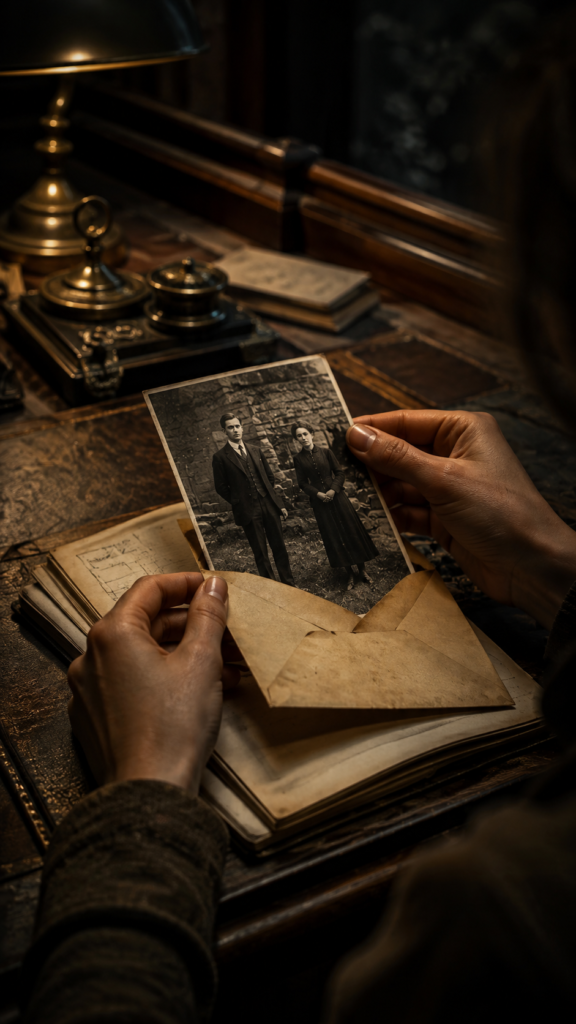
Something beneath it caught her attention. A small, yellowed envelope was partly hidden beneath the notebook, with only its edge visible against the dark wood.
She frowned. She was almost certain the desk had been empty when she entered the room.
For a moment, she simply stared at the envelope. It was possible that Eleanor had left it there before Clara arrived, or that it had been hidden beneath the notebook when she placed it on the desk. Still, Clara had developed a habit over the years of trusting the small details that other people overlooked.
She picked up the envelope carefully.
There was no name written on the front, no address, and no seal on the back. The paper had yellowed with age, and one corner was slightly bent. Clara opened it gently and found an old photograph inside.
The photograph showed a much younger Professor Whitmore standing beside a stone wall somewhere on the Silver Hill grounds. He was dressed in a dark coat and held several papers beneath one arm. Beside him stood a woman with her hands folded in front of her.
Clara brought the photograph closer to the lamp. She recognized the woman immediately. It was Eleanor.
She looked at least twenty years younger, with darker hair and a face that carried none of the tiredness Clara had noticed earlier. Yet there was something unmistakably familiar in the way she stood beside Whitmore, as though the photograph had captured a moment from a relationship that had lasted far longer than Clara had initially understood.
Clara turned the photograph over, expecting to find a date or perhaps a note explaining when it had been taken. Instead, there was a single sentence written across the back in black ink.
He trusted the wrong person.
Clara read the sentence twice.
Her first thought was that it might have been written by Whitmore, but the handwriting did not resemble the formal note beneath Jonathan Reed’s signature. This writing was sharper and more angular, with narrow letters that leaned slightly toward the right.
She looked toward the bedroom door.
The photograph had not simply appeared on the desk by accident. Someone had either placed it there deliberately or hidden it there before she arrived. Either possibility raised questions that Clara did not yet know how to answer.
She slipped the photograph carefully into her notebook and walked to the door. When she opened it, the corridor was empty. The wall lamps cast soft pools of light across the carpet, and somewhere farther down the hall she could hear the faint sound of a clock.
Clara stepped into the corridor and listened. Nothing.
She glanced toward the staircase before returning to the room. She closed the door and stood with her back against it for a moment, thinking about what she had just found.
Someone at Silver Hill wanted her to know that Eleanor Price had been connected to Professor Whitmore’s secrets for a very long time.
The question was whether the message was meant as a warning about Eleanor or a warning to Eleanor.
By the time Clara went downstairs, the smell of dinner had spread through the house. She followed it toward the dining room and found Eleanor arranging plates along a long wooden table beneath an old chandelier. A fire burned quietly inside the stone fireplace at the far end of the room, and the warmth was welcome after the cold upper corridor.
Eleanor looked up when Clara entered and smiled faintly. “Dinner is almost ready,” she said, placing a glass beside one of the plates. “You can sit wherever you’d like, although Professor Whitmore always preferred that chair near the fireplace.”
Clara glanced toward the chair Eleanor had indicated. She did not sit in it. Instead, she chose a seat several places away and placed her notebook beside her plate.
Eleanor noticed it immediately.
“You’ve found something,” she said. Clara looked at her. “I found a photograph in my room.”
The older woman’s hands stopped moving.
Clara opened the notebook and removed the photograph carefully. “I think you should see it.”
Eleanor turned toward her, and the moment she saw the image, the expression on her face changed. She stopped completely and stared at the photograph without touching it, as though the sight of her younger self standing beside Professor Whitmore had brought back something she had spent years trying not to remember.
“Where did you get that?” Eleanor asked quietly.
“It was beneath my notebook when I returned to my room,” Clara replied. “I didn’t put it there, and I don’t remember seeing it when I first arrived.”
Eleanor’s eyes remained fixed on the photograph. “That photograph shouldn’t be here.”
“Why?”
“Professor Whitmore kept it locked away.”
Clara leaned forward slightly. “You recognize it, then?”
Eleanor finally looked at her. “Yes.”
“You were there when this was taken.”
Eleanor nodded slowly. “Yes, I was.”
Clara pointed toward the papers beneath Whitmore’s arm.
“Do you remember when the photograph was taken?”
“Many years ago,” Eleanor replied. “Shortly after Professor Whitmore returned from France. He had been working on something connected to his research.”
Clara looked again at the papers. “Were those documents part of the collection I’m here to examine?”
Eleanor hesitated. “Some of them were,” she finally said.
Clara caught the hesitation. “What happened to the others?”
Eleanor moved toward the fireplace and stood with her back to the flames. “I don’t know. Professor Whitmore didn’t tell me everything about his work, and I learned a long time ago not to ask questions he didn’t want to answer.”
Clara picked up the photograph again. “What about this sentence? Did Professor Whitmore write it?”
Eleanor studied the words for several seconds before shaking her head. “I don’t know who wrote that.”
“You don’t recognize the handwriting?”
“No.”
“Did you put the photograph in my room?”
Eleanor’s expression hardened. “No.”
Clara held her gaze for several seconds before putting the photograph back inside the notebook. “Then someone else must have access to the house.”
“There are people who still have keys to certain parts of Silver Hill,” Eleanor admitted. “Mr. Reed has access to the main entrance, and some members of Professor Whitmore’s family have keys to various rooms. I don’t know who else might have copies.”
“Who in the family?” Eleanor’s expression changed again, and Clara immediately noticed it.
“Mrs. Price?”
“Professor Whitmore had a nephew and a niece,” Eleanor said carefully. “Neither lives nearby.”
“Did they know about the collection?”
“I assume they knew their uncle kept documents here.”
“That’s not what I asked.”
Eleanor looked directly at Clara.
“They knew he was protective of certain parts of the house. I don’t know what they knew about the collection itself.”
Clara was about to ask another question when a heavy sound came from somewhere above them.
Both women stopped.
The sound was not loud enough to shake the house, but it was unmistakable. A door had slammed somewhere on the upper floor. Clara looked toward the dining room entrance.
Eleanor’s face had lost its colour.
“Was that upstairs?” Clara asked.
Eleanor nodded slowly. “It sounded like it.”
Clara reached for her notebook. “Then we should check.”
“You should stay here.”
Clara gave her a sceptical look. “Someone has already entered my room without my knowledge, and now we’ve heard a door slam upstairs. I’m not going to sit downstairs while you investigate it alone.”
Eleanor hesitated. She clearly wanted to argue, but after a few seconds she gave a reluctant nod. “Stay close to me,” she said.
They left the dining room together.
The house seemed different now. The warmth from the fireplace disappeared almost immediately as they reached the hallway, and the silence seemed deeper than before. Eleanor climbed the stairs slowly, stopping once near the landing to listen. Clara remained close behind her, trying to ignore the uncomfortable sensation that someone might be watching them from somewhere above.
When they reached the upper corridor, Clara immediately noticed that the door to the Rose Room was open.
She stopped. “I closed that door,” she said quietly. “I’m certain I did.”
Eleanor glanced at her. “Are you sure?”
“Yes.”
The older woman approached the room first. Clara followed, and both stepped inside. Nothing appeared to be missing.
The bed was still made. Clara’s suitcase remained beside the wardrobe, and her camera bag was still on the desk. For a moment, she wondered whether she had simply imagined closing the door.
Then she noticed the notebook. It was lying open across the bed.
Clara stared at it. “I left that on the desk.”
Eleanor said nothing.
Clara walked toward the bed and looked down at the open page. Her own handwriting covered most of it, including the list of questions she had written earlier.
But beneath her final question, someone had written a message in dark ink.
Do not read the first letter alone.
Clara’s stomach tightened. She had not written those words.
She knew it immediately from the handwriting, which was different from hers and different from the writing on the back of the photograph.
She turned toward Eleanor. “Did Professor Whitmore ever leave messages like this?”
Eleanor stared at the page. “No,” she said eventually. “Not messages like this.”
“Then who wrote it?”
Eleanor did not answer.
Instead, she walked toward the window and looked down at the grounds. The trees moved in the wind, their branches crossing one another against the darkening sky.
Clara waited.
Eventually, Eleanor turned back toward her. “I don’t know who wrote this particular message,” she said quietly. “But I know what Professor Whitmore believed about the person who might one day try to interfere with his collection.”
Clara felt her attention sharpen. “What did he believe?”
Eleanor took a slow breath. “He believed someone had been searching for those documents for years.”
Clara glanced toward the notebook. “Searching for the collection?”
“Yes.”
“Who?”
“I don’t know.”
“Did Professor Whitmore know?”
Eleanor’s expression tightened. “I think he suspected someone. But he never told me the person’s name.”
Clara thought about Jonathan Reed’s warning. She remembered the solicitor’s quiet admission that he believed Whitmore had been frightened before his death, and she remembered the precaution he had taken to ensure that no one other than Clara could access the private collection.
“Did Whitmore think that person would come here?” Clara asked.
Eleanor looked toward the dark grounds again. “He was afraid they would.”
“Did he ever say why?”
“Not directly.”
Clara stepped closer.
“What did he say?”
Eleanor remained silent for several seconds before answering. “He once told me that the past had a way of attracting people who believed they could use it to change the present.”
Clara considered the sentence. “That sounds like something a historian would say.”
“It was more than that,” Eleanor replied. “He wasn’t speaking philosophically. He was afraid.”
Clara looked at the message again.
Do not read the first letter alone.
“Why would someone warn me not to read the first letter alone?”
Eleanor shook her head. “I don’t know.”
“Could it have something to do with the seven letters?”
“Perhaps.”
“Could the person who left this message know what’s inside them?”
Eleanor’s eyes met Clara’s. “Perhaps.”
The answer unsettled Clara more than a definite response would have. She closed the notebook and held it against her chest.
“Tomorrow morning, I want to see the collection.”
Eleanor looked at her for several seconds before nodding. “Then tomorrow morning, I’ll take you there.”
Clara glanced around the room. She had arrived at Silver Hill less than an hour earlier, yet the house already felt completely different from the place she had seen when she first stepped through its doors. What had seemed like an old estate filled with historical objects now felt like a place in which people had spent years protecting information from one another.
She looked toward the photograph hidden inside her notebook.
The younger Eleanor and Professor Whitmore stood beside one another, apparently unaware that someone would one day look at the image and wonder what they had been doing.
Clara thought about the seven letters. She thought about the fire in 1992. She thought about the symbol on the gates. Most of all, she thought about Whitmore’s decision to choose her despite never having met her.
There had to be a reason. And whatever that reason was, it was beginning to look as though it had very little to do with journalism.
Eleanor moved toward the doorway. “You should try to get some sleep.”
Clara nodded, although she knew sleep would probably be difficult.
As Eleanor reached the corridor, Clara stopped her. “Mrs. Price?”
The older woman turned.
“One more question.”
Eleanor waited.
“Why did Professor Whitmore trust you for twenty-three years?”
For the first time that evening, Eleanor looked genuinely caught off guard. Her expression softened for only a moment before the familiar guardedness returned.
“I don’t know if he did,” she said.
Clara frowned. “You were his caretaker for twenty-three years.”
“Being trusted to look after a house isn’t the same as being trusted with a man’s secrets.”
Eleanor left before Clara could respond.
Clara remained in the room, listening as the older woman’s footsteps faded down the corridor. She looked at the notebook in her hands and then toward the dark window.
Somewhere inside Silver Hill were seven letters Professor Whitmore had considered important enough to protect until his death. Someone had already entered Clara’s room, someone had placed an old photograph where she would find it, and someone had written a warning in her notebook.
The strange part was that none of it felt accidental.
Clara had come to Silver Hill expecting old documents, forgotten history, and perhaps an interesting story for her readers. Instead, within hours of her arrival, she had discovered that the collection was connected to a secret that had apparently survived for decades.
And someone else was still looking for it.
She turned off the lamp and closed the door behind her, unaware that at the opposite end of the corridor, a shadow moved briefly across the wall before disappearing into the darkness.
By the time Clara returned to the bedroom, the house had fallen completely silent again. She locked the door, placed the notebook inside her bag, and checked the window before sitting on the edge of the bed. She told herself that the message was only a warning, that whoever had written it wanted to frighten her rather than harm her, and that there would be a perfectly reasonable explanation once she saw the collection in the morning.
But as she lay beneath the heavy quilt, Clara could not stop thinking about one particular detail. Professor Whitmore had known that someone was searching for the letters. He had known enough to be afraid.
And despite knowing that, he had still chosen Clara Bennett to come to Silver Hill and read them. Whatever was hidden inside those seven letters, she was beginning to suspect that the first letter would not simply tell her a story about the past.
It would tell her why she had been brought to Silver Hill in the first place.
THE LETTERS OF SILVER HILL
Continue the mystery
NEXT EPISODE →